Elevating Environmental Storytelling with the 3D Climate Change Pack
In the current digital landscape, communicating complex global issues like climate change requires more than just data; it demands visual impact. As environmental awareness grows across industries, designers and content creators are under increasing pressure to produce imagery that resonates emotionally while maintaining technical precision. This is where specialized asset libraries become indispensable. The 3D Climate Change Pack emerges as a targeted resource for professionals seeking high-quality, thematic illustrations to bolster their projects related to pollution, energy, and planetary health.
This collection is not merely a folder of random images; it is a curated suite of 3D designs specifically engineered to address the visual needs of modern environmental campaigns. Whether you are building a dedicated climate change website, designing a UI/UX interface for an eco-friendly app, or creating physical marketing materials like banners and posters, having access to cohesive, high-resolution assets can significantly streamline your workflow. The pack bridges the gap between conceptual ideas and final execution, offering a foundation upon which compelling narratives about global warming and sustainability can be built.
Technical Specifications and Asset Versatility
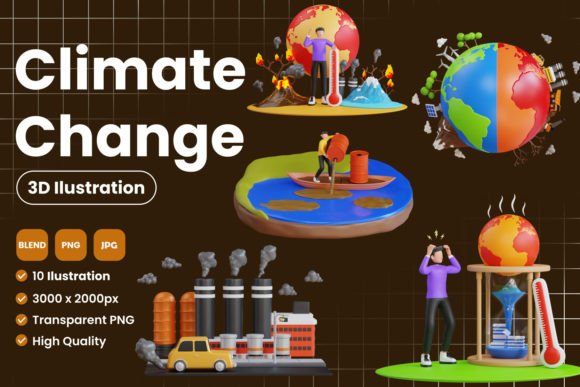
One of the primary strengths of the 3D Climate Change Pack lies in its comprehensive file delivery. Understanding that different stages of a design project require different formats, the package includes a robust mix of source files and ready-to-use renders. Specifically, users receive 10 3D Blender files, which is a critical inclusion for any designer who values flexibility. Unlike static image packs that lock you into a specific angle or lighting setup, having the native Blender files allows for complete customization. You can adjust camera angles, modify lighting conditions to match your brand's mood, or even integrate additional elements into the scene before rendering.
For those who need immediate deployment without the time investment of 3D rendering, the pack also provides 10 JPG and 10 PNG files. These are not low-resolution web previews; they are High-Resolution Images sized at 3000x2000 pixels. This resolution ensures that the graphics remain crisp and detailed whether they are displayed on a retina desktop monitor or printed on large-format posters. The inclusion of PNG files with transparent backgrounds is particularly useful for UI/UX designers who need to layer these 3D elements over various interface backgrounds without dealing with cumbersome clipping masks.
Compatibility is another area where this collection demonstrates practical foresight. The assets are designed to work seamlessly within the Adobe ecosystem, specifically Adobe Photoshop and Illustrator, as well as Blender. This triad of software coverage ensures that the pack fits into almost any standard creative workflow. A graphic designer can take a rendered JPG into Photoshop for color grading and text overlay, while a vector artist might use the shapes as references in Illustrator for iconography. Meanwhile, 3D generalists can open the Blender files to create animated sequences for social media or interactive web experiences.
Visual Quality and Thematic Consistency
When evaluating visual assets for professional use, consistency is paramount. A common pitfall with stock photography or disparate 3D downloads is the lack of a unified aesthetic, which can make a final project feel disjointed. The 3D Climate Change Pack addresses this by maintaining a consistent visual language across all ten designs. The illustrations cover essential themes such as pollution, the state of the earth, renewable energy sources, and the effects of global warming. Because they share similar lighting styles, texture qualities, and compositional balances, they can be used together in a single campaign without clashing.
The quality of the 3D modeling itself appears geared towards a modern, clean look that avoids the uncanny valley often found in lower-tier 3D assets. The representations of environmental concepts are stylized enough to be engaging but realistic enough to convey seriousness. For instance, depictions of industrial pollution or melting ice caps are rendered with sufficient detail to evoke the intended emotional response without becoming overly grotesque or abstract. This balance makes the pack suitable for a wide range of audiences, from educational materials for students to corporate sustainability reports for stakeholders.
Practical Applications for Diverse Professionals
The utility of the 3D Climate Change Pack extends far beyond a single type of user. Its versatility makes it a valuable tool for a broad spectrum of professionals aged 20 to 50 who are actively involved in content creation and strategic communication.
- Web Designers and Developers: For those building a Climate Change website, these assets serve as perfect hero images or section dividers. The high resolution ensures fast loading times when optimized, while the 3D depth adds a modern touch that flat design sometimes lacks.
- UI/UX Designers: Creating an app focused on carbon footprint tracking or energy conservation? The PNG files allow you to decorate your UI/UX with relevant icons and illustrations that enhance user engagement without cluttering the interface.
- Marketers and Advertisers: When crafting banner ads or social media campaigns for Earth Day or environmental initiatives, having pre-made, high-quality visuals reduces production time. You can focus on copywriting and strategy rather than spending days modeling scenes from scratch.
- Educators and Publishers: Textbooks, online courses, and presentation decks regarding environmental science benefit greatly from clear, accurate 3D illustrations. These images can help visualize abstract concepts like the greenhouse effect or ocean acidification for learners.
- Small Business Owners: Eco-conscious brands looking to highlight their sustainability efforts can use these images in their poster files or annual reports to visually align their business values with global environmental goals.
Workflow Efficiency and Long-Term Value
From a project management perspective, the value of the 3D Climate Change Pack is measured in time saved. Creating high-fidelity 3D environments involving complex elements like atmospheric effects, water simulations, or intricate mechanical parts for energy systems can take hours or even days for a single artist. By leveraging this pack, freelancers and agencies can bypass the initial modeling phase and move straight to composition and refinement. This efficiency is crucial when working with tight deadlines or limited budgets.
Furthermore, the possession of the source Blender files adds a layer of long-term value. As design trends evolve, you may need to update the look of your assets. Having the source files means you are not stuck with the images as they were delivered in 2024; you can re-render them in five years with updated lighting engines or stylistic tweaks to keep your content fresh. This future-proofs your investment and ensures that the assets remain relevant for ongoing campaigns.
Limitations and Considerations
While the 3D Climate Change Pack offers significant advantages, it is important to approach it with realistic expectations. The pack contains ten distinct designs. For a massive, multi-year campaign requiring hundreds of unique visuals, this quantity might serve as a starting point rather than a complete solution. Users may need to combine these assets with other resources or utilize the Blender files to create variations through cropping, color shifting, or compositing.
Additionally, while the resolution of 3000x2000 is excellent for most digital and standard print uses, extremely large-scale outdoor advertising (such as billboards viewed from close range) might require upscaling or careful handling to maintain pixel perfection, though the 3D source files mitigate this risk if re-rendered at higher resolutions locally.
Final Verdict on Utility
In an era where visual communication drives public perception of critical issues, the quality of your imagery matters. The 3D Climate Change Pack stands out as a pragmatic, high-value resource for anyone needing to visualize environmental themes professionally. It successfully balances artistic appeal with technical usability, offering both ready-to-go raster images and editable 3D sources.
For marketers, designers, and educators looking to enhance their projects related to pollution, energy, and global warming, this collection provides a solid foundation. It eliminates the friction of sourcing inconsistent stock photos and offers the flexibility needed for custom branding. If your goal is to produce impactful, coherent, and visually stunning content that respects the gravity of climate change while engaging your audience, integrating this pack into your workflow is a logical and effective step forward.